Angelic Hierarchy
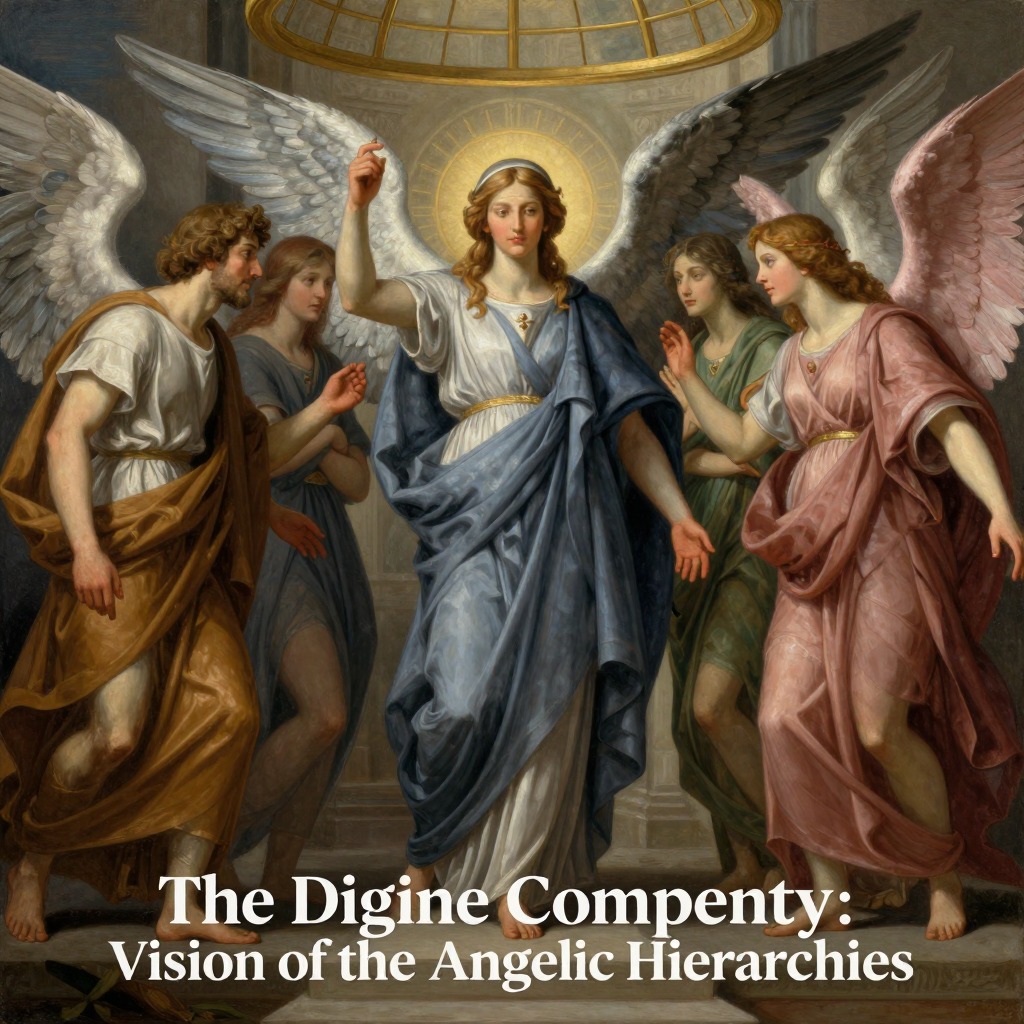
The Angelic Hierarchy constitutes the organizing principle of Dante's Paradise, a ninefold structure of angelic orders that both governs the celestial spheres and embodies the metaphysical order of the universe. Beatrice reveals this hierarchy to Dante during their ascent through the heavens, explaining that the ranks of angels are arranged according to their nearness to God and their power of vision, and that this order is the pattern by which all creation is measured.
Structure and Organization
The Angelic Hierarchy is composed of nine orders arranged in three triads. The first triad, closest to God, consists of the Seraphim, Cherubim, and Thrones. The second triad comprises the Dominions, Virtues, and Powers. The third and lowest triad includes the Principalities, Archangels, and Angels. These orders are arranged in concentric circles around a single, infinitely bright point that represents God. The circles move with varying speeds: those closest to the divine point revolve most swiftly, driven by the intensity of their love and vision, while those farther away move more slowly. Beatrice explains that the speed of each circle corresponds to the degree of its love and knowledge, and that the entire hierarchy is dependent on the central point from which all being and motion proceed.
The Three Triads and Their Functions
The first triad, comprising the Seraphim, Cherubim, and Thrones, is the most exalted and most directly participates in the divine nature. The Seraphim, burning with the most intense love, are the closest to God. The Cherubim are associated with the fullness of knowledge. The Thrones are so called because they terminate the first triad and are the seat of the divine judgment. The second triad—Dominions, Virtues, and Powers—governs the execution of divine will throughout the cosmos. The third triad—Principalities, Archangels, and Angels—is responsible for the direct governance of the material world and the guardianship of human affairs. Beatrice emphasizes that all the orders gaze upward toward God and also exert influence downward, so that the entire hierarchy is both attracted to and attracted by the divine source.
The Hierarchy's Relation to the Celestial Spheres
The nine orders of angels are intimately linked to the nine celestial spheres of Paradise. Each sphere is moved by its corresponding angelic order, and the nature of the sphere reflects the character of the angels that govern it. The Primum Mobile, the swiftest and outermost sphere, is moved by the Seraphim, the order most inflamed with love. The lower spheres, such as the Moon, Mercury, and Venus, are moved by the lower orders. This correspondence between angelic rank and celestial motion demonstrates the unity of the spiritual and physical orders in Dante's cosmos. Beatrice explains that the material heavens are not arranged by size alone but by the virtue and power they receive from the angelic intelligences that move them, so that the greatest goodness produces the greatest weal and the largest body.
Theological Sources and Dante's Adaptation
Dante's Angelic Hierarchy is directly derived from the writings of Dionysius the Areopagite, who first systematized the nine orders. Beatrice explicitly names Dionysius as the authority who "named them and distinguished them as I do." She notes that Pope Gregory I later dissented from Dionysius's ordering, but that Gregory, upon arriving in heaven, smiled at his own error. Dante thus affirms the Dionysian scheme as the correct one, validated by the direct vision of the blessed. The hierarchy also reflects the broader medieval understanding of the universe as a ordered, hierarchical structure in which every being has its proper place and function, and in which the lower is perfected by the higher.
Significance in the Poem
The Angelic Hierarchy serves as the structural and theological backbone of the Paradiso. It provides the framework for Dante's ascent through the nine heavens, each of which is governed by a different order of angels and reveals a different aspect of divine truth. The hierarchy also illustrates the principle that beatitude consists in the vision of God, not in the exercise of love alone, for the angels' joy is proportionate to their intellectual vision of the divine essence. By understanding the hierarchy, Dante—and the reader—grasps the order that pervades all creation and the way in which every creature, from the highest seraph to the lowest human soul, is drawn toward God by the love that moves the sun and the other stars.